
Anderson Cooper reports on the busloads of men, women and children from Central and South America arriving in New York City.

Anderson Cooper reports on the busloads of men, women and children from Central and South America arriving in New York City.
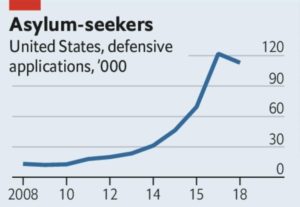
It is a familiar pattern. The president says something outrageous—this time Donald Trump told four black and brown-skinned Democratic congresswomen, all of whom are us citizens and three of whom were born in America, to “go back” where they came from. His supporters, who have come to accept what many of them previously found unconscionable, stay silent. His opponents, rightly appalled, lament what has happened to their country. At the same time the Trump administration makes a big policy change that attracts far less attention—in this case, an edict that directly affects tens of thousands of people a year and overturns half a century of precedent.

The US (especially NYC) has been a melting pot of cultures, providing opportunity to those looking to make a better life. There have been ebbs and flows in policy since the Supreme Court made immigration a federal responsibility in 1875. An initial quota system emerged in the 1920s because of concerns over employment and jobs as well as fear of foreigners. In 1942 the U.S. agreed with Mexico in the Mexican Farm Labor of Agreement for the managed importation of migrant labor at an equilibrium of minimum wage for basic human rights.
But rarely have the tides of immigration swung back and forth as rapidly or as violently as they are today.
Immigration is a policy managed predominantly at the federal level. Key topics include US citizenship, family-based immigration, employment-based immigration (temporary visas and permanent immigration), refugees and “asylees” as well as other diversity visa and humanitarian relief programs. There are approximately 876,000 visas available each year for US bound immigrants.
Yet visas are oversubscribed, and it is estimated that there are approximately 11- 12 million illegal immigrants in the United States. Six states, including New York, house more than 60% of the total.

The Impact Public Service Fund exists to promote effective government of, for, and by the people. When a citizen’s ability to get straight answers on issues that affect them is compromised, Impact is here to help.
To that end, our team is launching an original video series: Impact Spotlight. Each 15-minute piece will arm you with the facts you need to be be a part of the global dialogue on a key topic of the day. No agenda, no spin—we don’t care what your opinion is, as long as it’s informed.
Our first video, “The Worlds Busiest Border,” addresses the US-Mexico Border. For decades, politicians have used the Southwestern border to frame arguments around immigration, jobs, security, and more. In contrast, we get straight to the facts: what when did the border come about, what’s actually there today, who’s crossed it, what effect do our laws have?
We hope you’ll use this and future Impact Spotlight videos as a platform to develop your own civic expertise and engagement. Either way, please let us know what you think. Like the American government itself, in the Impact community, your opinion doesn’t just matter—it’s all that matters.